You know the feeling. Forty seconds into a shift, the puck is still in your zone, your legs are burning and you are breathing so hard you can’t call for the pass. Then you get to the bench and spend half your rest just trying to catch your breath.
Most players blame their legs or their conditioning. Often, part of the problem is breathing: how hard your breathing muscles are working, how fast you recover between shifts, and how you breathe under pressure. The good news is that all three can be trained.
Why Breathing Matters in Hockey
A hockey shift is short, hard and repeated. You sprint, battle, glide and sprint again, then sit for a couple of minutes and do it all over. That pattern puts heavy demands on your breathing:
- During the shift, breathing rate and depth climb fast, and your diaphragm and rib muscles work hard while your skating posture keeps your chest bent forward.
- On the bench, how quickly your breathing settles affects how recovered you are for the next shift.
- Late in the game, tired breathing muscles add to the overall sense of fatigue.
Research in endurance exercise has shown that when the breathing muscles work very hard, the body can redirect some blood flow toward them and away from the working legs. Hockey is not an endurance race, but it is a game of repeated high-intensity efforts, and breathing muscles that tire less are one more advantage late in a period.
Three Things Hockey Players Can Train
1. Respiratory muscle strength
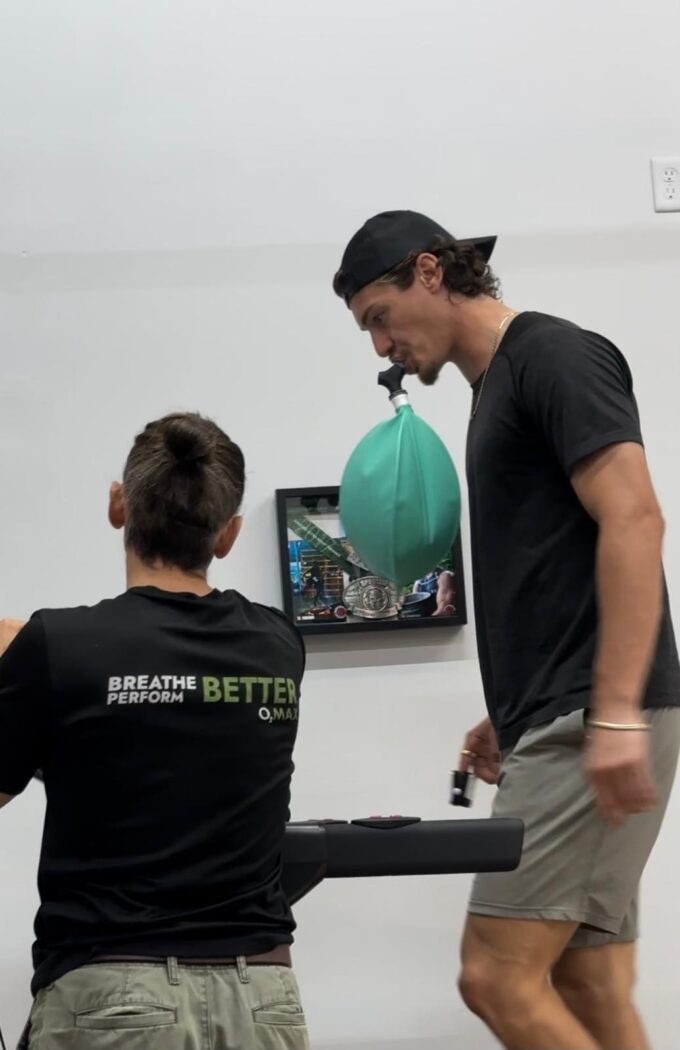
Your diaphragm is a muscle, and it responds to training like any other. Respiratory muscle training means breathing against an adjustable resistance for a short set, usually once or twice a day. It takes a few minutes and can be done at home, in the dressing room or on the bus. See Respiratory Muscle Training: How to Get Started for a simple routine.
2. Bench recovery
Most players come off the ice and breathe fast and shallow through the mouth, with shoulders up. Try this instead for the first minute on the bench:
- Sit tall, with your hands resting on your thighs rather than hanging over the boards.
- Breathe out fully and slowly through pursed lips, as if fogging a mirror.
- Let the next breath come in low, so your belly and sides expand before your chest.
- Gradually slow the exhale until it is longer than the inhale.
It feels slower at first. With practice in training, it becomes automatic in games.
3. Breathing under pressure
Many players hold their breath during battles, faceoffs and shots. A short, forceful exhale on contact or release, like a boxer’s punch, keeps the trunk braced without locking up your breathing. Practice it in dryland first, during med-ball throws and sprint starts.
Adding Breathing Work to Dryland
You don’t need extra hours. Two or three short pieces a week are enough to start:
- Warm-up: two minutes of slow nasal breathing with long exhales before you start moving fast.
- Intervals: shift-length efforts of 30 to 45 seconds with 1 to 2 minutes of rest, practicing the bench recovery steps in every rest.
- Daily: a short respiratory muscle training set, morning and evening.
- Cool-down: a few minutes lying on your back, breathing low and slow to start recovery.
For younger players, keep it simple and playful: the goal is good habits, not heavy loads. Coaches can build breathing cues into drills they already run.
Measure, Then Train
Every player is limited by something different. A breath-by-breath VO2 max test shows how your breathing rate and volume respond as effort climbs, where your fuel use shifts and how quickly you recover, so training targets what is actually holding you back. O2Max also runs onsite breathing programs for teams.
Sources
- Harms CA, et al. Respiratory muscle work compromises leg blood flow during maximal exercise. Journal of Applied Physiology. 1997;82(5):1573–1583. Read the study
- Illi SK, Held U, Frank I, Spengler CM. Effect of respiratory muscle training on exercise performance in healthy individuals: a systematic review and meta-analysis. Sports Medicine. 2012;42(8):707–724. Read the abstract
This article is for general education and is not medical advice. Talk to your physician before starting a new exercise program or testing.
Train Your Team’s Breathing
Onsite respiratory muscle training and optional VO2 max testing for hockey teams and athletes.